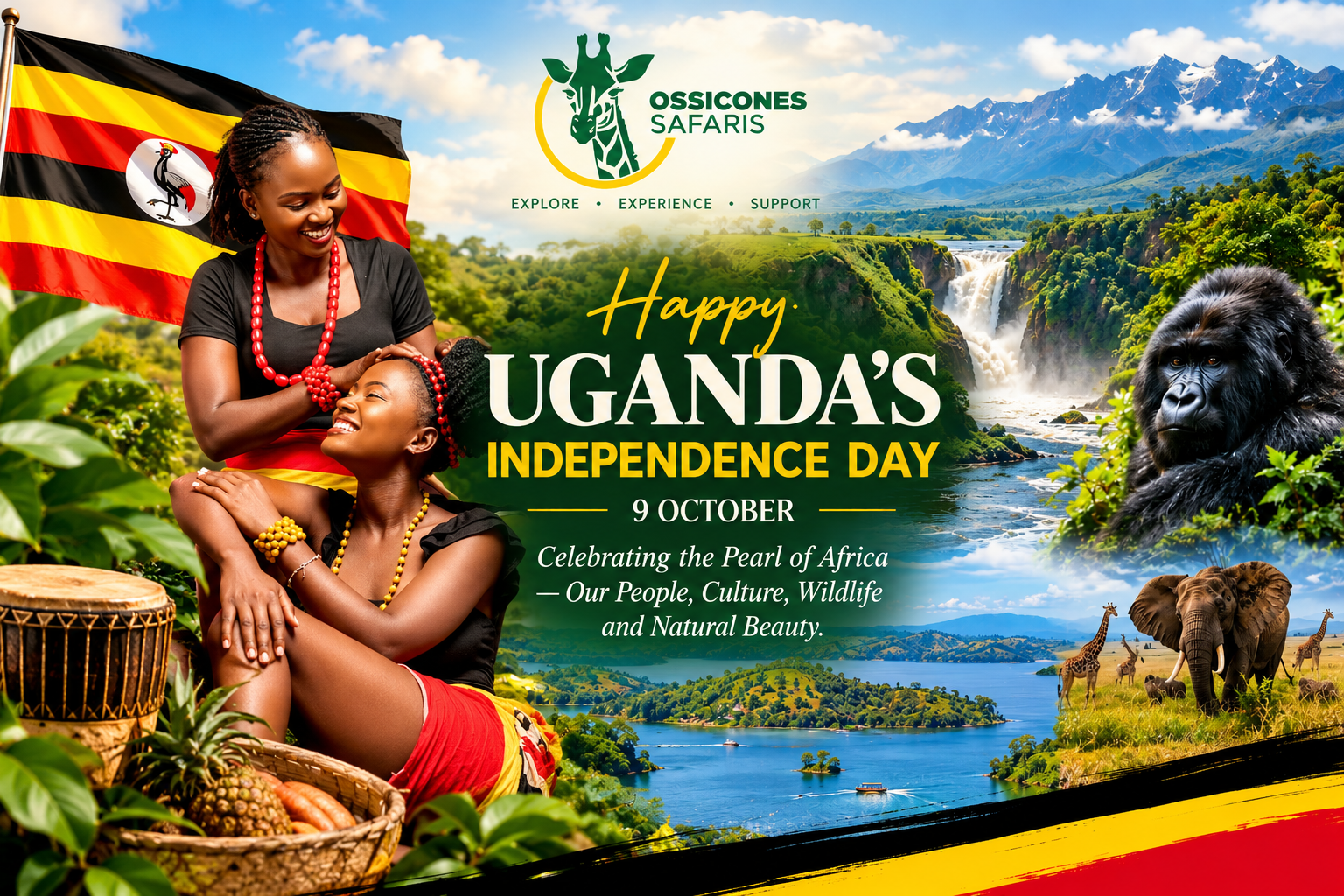
Uganda’s Independence: Celebrating the Pearl of Africa’s People, Culture and Natural Wonders
Explore Uganda. Discover a nation where freedom, culture, wildlife and extraordinary natural beauty come together.
Every year on 9 October, Uganda celebrates a defining moment in its history: the day the country attained independence from British colonial rule in 1962. It is a day of national pride, reflection and celebration—a reminder of how far the nation has come and the remarkable heritage that continues to shape its identity.
But Uganda’s Independence Day is more than a commemoration of history. It is also an opportunity to celebrate everything that makes this country special: its welcoming people, vibrant cultures, breathtaking landscapes, abundant wildlife and the natural treasures that have earned it the beloved name “The Pearl of Africa.”
At Ossicones Safaris, we believe that discovering Uganda means experiencing more than beautiful destinations. It means connecting with the people, traditions, stories and natural wonders that make every journey unforgettable.
Uganda: A Pearl Shaped by Nature
Uganda’s identity as the Pearl of Africa reflects the remarkable diversity of experiences found within its borders. From the mist-covered mountains of the southwest to the sweeping savannahs of the north, from the freshwater shores of Lake Victoria to the powerful currents of the River Nile, the country offers an extraordinary collection of natural attractions.
The phrase “Pearl of Africa” is widely associated with Winston Churchill, who popularised it following his travels through Uganda in the early twentieth century. More than a century later, the description remains a fitting tribute to the country’s extraordinary natural beauty.
Uganda’s landscapes tell different stories in every direction. The snow-capped Rwenzori Mountains rise above western Uganda, while Mount Elgon dominates parts of the eastern landscape. Murchison Falls showcases the mighty Nile forcing its way through a narrow rocky gorge before plunging into the river below. Lake Bunyonyi offers peaceful scenery among terraced hills, while the open plains of Queen Elizabeth National Park reveal a world of wildlife, crater lakes and spectacular sunsets.
These are not merely places to visit. They are experiences that invite travellers to slow down, appreciate nature and discover the richness of a country gifted with extraordinary geographical diversity.
The People: Uganda’s Greatest Treasure
While Uganda’s landscapes capture the eye, its people often capture the heart.
Uganda is home to many ethnic communities, each contributing unique languages, traditions, beliefs, music, food and ways of life. From the Baganda, Banyankole, Bakiga and Batoro to the Acholi, Langi, Iteso, Basoga, Banyoro and many other communities, the country’s cultural diversity is an essential part of its national identity.
One of the most rewarding experiences for visitors is the opportunity to meet local communities and learn about their everyday lives. A conversation with a local guide, a visit to a traditional homestead, a market walk or a shared meal can reveal aspects of Uganda that no photograph alone can fully communicate.
Hospitality is central to the experience. Visitors are often welcomed with warmth, curiosity and a genuine willingness to share. Through storytelling, dance, traditional music and local cuisine, travellers gain a deeper appreciation of the values and customs that have been passed from one generation to another.
As Uganda celebrates its independence, these communities remind us that the country's greatest strength lies not only in its natural resources, but also in the people who preserve its heritage, welcome its visitors and contribute to its future.

A Living Cultural Heritage
Uganda’s cultural richness can be experienced in many different ways.
In central Uganda, the Buganda Kingdom offers opportunities to explore royal history, traditional architecture and the significance of cultural institutions. In western Uganda, visitors can discover the heritage of the Bunyoro, Toro and Ankole regions, including royal traditions, cattle-keeping practices and distinctive cultural expressions.
Northern Uganda is known for its vibrant Acholi cultural heritage, including energetic traditional dances, music and storytelling. In the east, the Basoga, Bagisu and other communities contribute their own distinctive traditions, celebrations and culinary experiences.
Food is another important part of this cultural journey. Travellers can enjoy matooke, groundnut sauce, millet dishes, traditional vegetables, locally prepared fish and many other regional specialities. Each meal offers an opportunity to discover how geography, agriculture and cultural heritage shape Ugandan life.
Cultural tourism also provides an opportunity to support local artisans, performers, guides, farmers and community enterprises. When approached respectfully, it helps keep traditions alive while ensuring that tourism contributes to the livelihoods of the people who make Uganda special.
Independence, therefore, is also a celebration of cultural identity—the freedom to preserve, express and share the many traditions that collectively define the nation.
Uganda’s Wildlife: A Natural Heritage Worth Protecting
For wildlife enthusiasts, Uganda is a destination of exceptional diversity. Its national parks, forests, wetlands and lakes support a remarkable range of animals and birdlife.
In Bwindi Impenetrable National Park and Mgahinga Gorilla National Park, visitors can experience the extraordinary privilege of encountering endangered mountain gorillas in their natural habitat. These encounters offer a powerful reminder of the importance of conservation and the protection of fragile ecosystems.
Kibale National Park is renowned for chimpanzee tracking and its rich primate diversity. Queen Elizabeth National Park combines savannah wildlife, wetlands and the famous Kazinga Channel, where boat trips offer opportunities to observe hippos, elephants, crocodiles and numerous bird species. In the Ishasha sector, travellers may have the chance to spot the region’s famous tree-climbing lions.
Further north, Murchison Falls National Park combines dramatic scenery with opportunities to see elephants, giraffes, buffaloes, antelopes, lions and other wildlife. A boat cruise towards the base of the falls offers a memorable perspective of the Nile and the animals that depend on its waters.
For travellers seeking quieter wilderness experiences, Lake Mburo National Park offers opportunities to encounter zebras, impalas, elands and other savannah species. Kidepo Valley National Park, in the remote northeastern corner of the country, rewards visitors with rugged mountain scenery, expansive plains and a distinctive wilderness atmosphere.
Uganda is also a paradise for birdwatchers, with wetlands, forests, lakeshores and grasslands supporting an impressive variety of bird species, including the iconic grey crowned crane.
These wildlife experiences are part of Uganda’s natural inheritance. Protecting them requires responsible tourism, well-managed protected areas, community participation and a commitment to ensuring that future generations can continue to enjoy the country’s biodiversity.
The Rivers, Lakes and Mountains That Define the Pearl
Uganda’s natural endowments extend far beyond its famous national parks.
Lake Victoria, shared by Uganda and neighbouring East African countries, shapes livelihoods, transport, fishing and tourism. Its shores offer scenic retreats, islands and opportunities for boat excursions. The Ssese Islands, for example, provide a peaceful escape surrounded by water, forests and lakeside communities.
The River Nile is another defining feature of Uganda’s landscape. Its journey from the Lake Victoria region creates opportunities for sightseeing, boat trips and adventure tourism around Jinja and other destinations. For adventure seekers, the Nile region is associated with activities such as white-water rafting, kayaking and other water-based experiences offered by local operators.
Uganda’s waterfalls are equally captivating. Murchison Falls is among the country's most dramatic natural attractions, while Sipi Falls on the slopes of Mount Elgon rewards visitors with beautiful cascades, hiking trails and sweeping views of the surrounding countryside.
The country’s fertile soils and favourable growing conditions also support coffee, tea, bananas, cocoa and many other agricultural products. Coffee experiences, plantation visits and farm tours provide travellers with opportunities to understand the relationship between Uganda’s natural environment, its rural communities and its economy.
Together, these landscapes reveal a country where adventure, relaxation, wildlife and cultural discovery can be combined within one remarkable destination.
The Story Behind Uganda’s National Symbols
Independence gave Uganda more than political sovereignty. It also gave the nation the opportunity to establish national symbols that express its identity, aspirations and shared heritage.
The national flag, coat of arms and national anthem remain important reminders of the people and ideas that helped shape modern Uganda.
The Uganda National Flag

Uganda’s national flag was officially adopted on 9 October 1962, the day of independence. It consists of six horizontal stripes arranged in black, yellow and red, repeated twice, with a white disc in the centre containing the grey crowned crane.
The colours carry important national meanings:
Black represents the people of Africa.
Yellow represents Africa’s sunshine.
Red represents African brotherhood and the bonds that connect humanity.
The grey crowned crane (Engaali), Uganda’s national bird, is a distinctive emblem of the country. Described for it's peace & gentleness, Uganda's natural herritage, National Identity, and Progress and Hope as it stands with one leg with the other raised making a step.

The flag is credited to Grace Ibingira, Uganda’s Minister of Justice at the time, who played a key role in developing the final design. Historical accounts also recognise the contribution of Professor Todd, a South African artist and teacher at Makerere College, who worked on the design of the flag.
Their work helped give independent Uganda a recognisable national identity that continues to be displayed with pride at public celebrations, schools, government institutions and homes across the country.
The Uganda Coat of Arms

Uganda’s coat of arms brings together several images that reflect the country’s natural wealth, culture and national aspirations.
At its centre is a shield with waves representing the country’s lakes, the sun symbolising Uganda’s sunshine and the traditional drum representing cultural life, ceremonies and community gatherings. Two spears behind the shield represent the willingness of Ugandans to defend their country.
The shield is supported by two important national symbols: the grey crowned crane and the Uganda kob, the latter representing the country’s abundant wildlife. Beneath them is a green mound representing fertile land, together with the River Nile and illustrations of coffee and cotton.
The national motto appears at the bottom:
“For God and My Country.”
The coat of arms is credited to Professor Todd, who worked at the School of Fine Art at Makerere College. Its imagery remains a powerful reminder that Uganda’s identity is closely connected to its people, fertile soils, cultural traditions, wildlife and waterways.
The Uganda National Anthem
Few moments capture national pride as powerfully as hearing Ugandans sing their national anthem together.
The anthem, Oh Uganda! May God Uphold Thee, expresses hope, unity, freedom and a shared commitment to the nation. Its words also celebrate Uganda’s natural abundance, making it especially meaningful during Independence Day celebrations.
The music was composed by George Wilberforce Kakoma, while the lyrics were developed through a collaborative process involving Kakoma and Peter Wingard, a lecturer at Makerere College. The national symbols committee was chaired by Professor Ssenteza Kajubi, who played an important role in the selection process.
The committee also included figures such as Reverend Polycarp Kakooza, Mbabi Katana, William Nadiope and John Moon.
One of the anthem’s most enduring expressions describes Uganda as:
“The Pearl of Africa’s Crown.”
These words connect the country’s national identity directly to the natural beauty and fertile land that continue to attract travellers from around the world.
The stories behind these symbols remind us that nation-building is a collective effort. Artists, musicians, educators, public servants and cultural leaders all contributed to the symbols that Ugandans proudly recognise today.
Independence and the Future of Ugandan Tourism
As Uganda celebrates its independence, tourism offers an important opportunity to translate the country’s natural and cultural wealth into sustainable benefits for its people.
Tourism creates opportunities for local guides, drivers, accommodation providers, craftspeople, farmers, conservation workers and community enterprises. It also encourages the preservation of cultural heritage and supports the protection of wildlife habitats that might otherwise face increasing pressure.
However, the future of tourism depends on responsible choices. Visitors can contribute by respecting local customs, supporting legitimate local businesses, reducing waste, following wildlife-viewing guidelines and choosing experiences that benefit surrounding communities.
For tour operators, the responsibility extends beyond organising memorable holidays. It includes promoting Uganda honestly, respecting its people and environment, and helping travellers understand why its natural and cultural treasures deserve protection.
At Ossicones Safaris, we see every journey as an opportunity to connect visitors with the real Uganda: its extraordinary landscapes, rich cultural heritage, remarkable wildlife and the welcoming communities that bring the country to life.
Celebrate Uganda’s Independence by Discovering the Pearl of Africa
Independence Day invites every Ugandan to reflect on the nation’s journey and every visitor to appreciate what makes this country extraordinary.
Imagine beginning your morning with the sounds of birds across a quiet wetland, spending the afternoon watching elephants in a national park, and ending the day sharing stories and traditional food with a local community. Imagine trekking through misty forests in search of mountain gorillas, following the Nile through dramatic landscapes, or exploring the cultural heritage of Uganda’s historic kingdoms.
These are the experiences that make Uganda more than a destination. They make it a place to discover, appreciate and remember.
As we commemorate the independence achieved on 9 October 1962, we celebrate the freedom, diversity, resilience and natural abundance that define our country.
Uganda is blessed with extraordinary people, living traditions, fertile landscapes and wildlife that inspire visitors from every corner of the world. These treasures are a source of national pride and a responsibility we all share.
Happy Independence Day, Uganda!
May the Pearl of Africa continue to shine through its people, culture, wildlife and breathtaking natural beauty.
Discover Uganda with Ossicones Safaris
Ready to experience the Pearl of Africa for yourself?
Whether you dream of gorilla trekking, wildlife safaris, cultural encounters, scenic landscapes or adventures along the River Nile, Ossicones Safaris is ready to help you discover Uganda through meaningful and memorable travel experiences.
Explore Uganda. Experience its heritage. Discover its natural wonders.
Ossicones Safaris — Unveiled Experience.